Why, what and how?
BBMRI.cz
Every cook knows that you need quality ingredients to prepare an excellent dish. Imagine a cake: if you make the base from old flour, then even with an outstanding cream and beautiful decoration, you will still taste the base. So despite all the time, effort and material invested, what you hold in your hands is a cake that is not quite perfect.
Research works in a similar way. If you start your investigation with poorly processed samples, you can carry out the best, most detailed and most time-consuming analyses, but you are still working with poor-quality samples and you do not know what is caused by the experiment and what by the low quality of the sample. So despite all the time, effort and material invested, what you hold in your hands are ambiguous results.
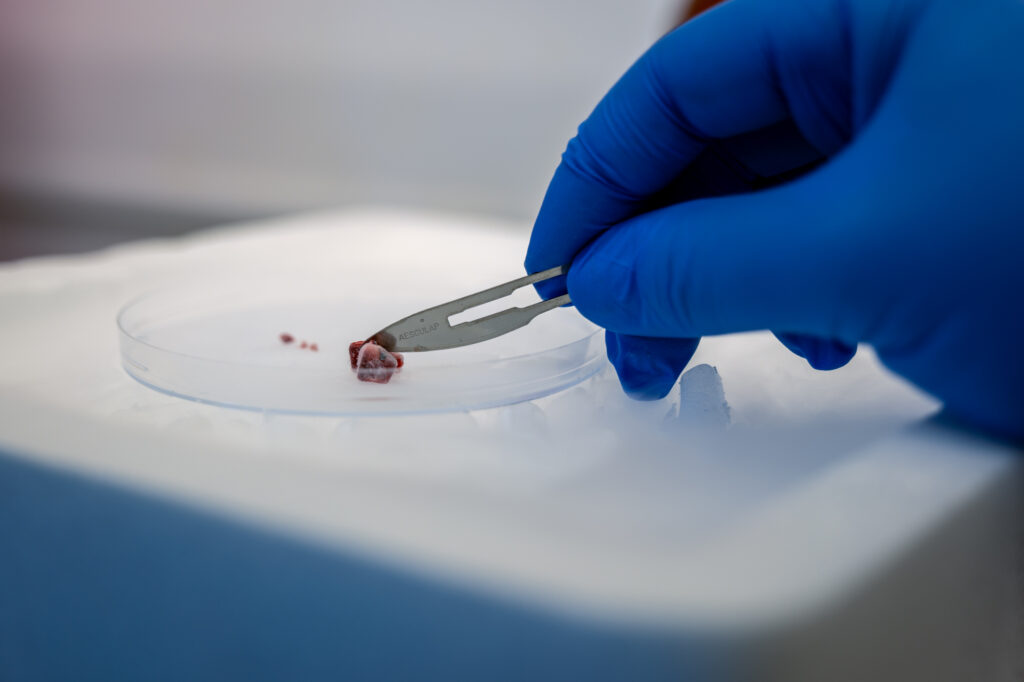
They say: “Your research is only as good as your samples.”
That is exactly why BBMRI.cz, the Network of Czech Biobanks (a large research infrastructure established by the state), was created: to make high-quality biological material more accessible to scientists. Our 8 member biobanks provide long-term stored and processed samples and data for scientific and research purposes. It is worth mentioning that some biobanks can also collect samples “prospectively” according to the user’s specifications.
So what exactly is a biobank?
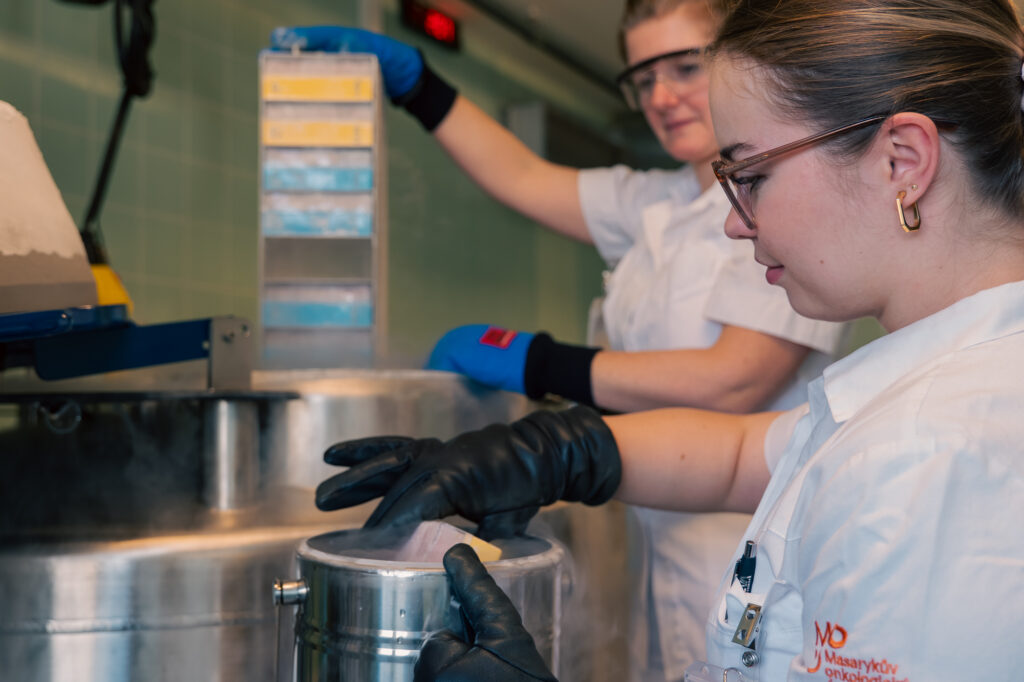
It is a network of several specialised departments that professionally process biological material (= samples), which is then secured and monitored during storage in the biobank and subsequently provided for research.
What is a sample in a biobank?
A sample can most easily be imagined as a tube that is frozen, most often at -80°C in a freezer or at -176°C in a liquid nitrogen container. Inside the tube is either 1–2 ml of blood/serum/plasma or a piece of tissue taken from a biopsy (3 x 3 mm). For each stored sample, the donor has signed an informed consent, and the sample is stored in several tubes.

What is the data linked to a sample?
This is the basic data provided with a sample (age, sex, diagnosis). If more detailed information is requested, biochemical, clinical or pathological data may also be provided. Data identifying the donor are never provided.
What is an aliquot?
Imagine a jug of water with syrup. You stir it and then pour it into 4 glasses. Each of these glasses contains the same thing that was in the jug, so each is an aliquot = it contains a part of a homogeneous sample.