Biological Sample Workflow
Research is only as good as the material used in it!
The quality of the biological material needed for research depends on the quality of the individual processes, which fall primarily under quality management:
- Indication, sampling, processing and characterisation of the material, and linking of data within a secure hospital database administered by an authorised person.
- Cataloguing, storage and regular quality control of the biological material.
- Subsequent, controlled release of biological material and the corresponding data for bio/medical research, represented by a suitable entity that meets and guarantees the basic requirements for the protection and integrity of experimental data.
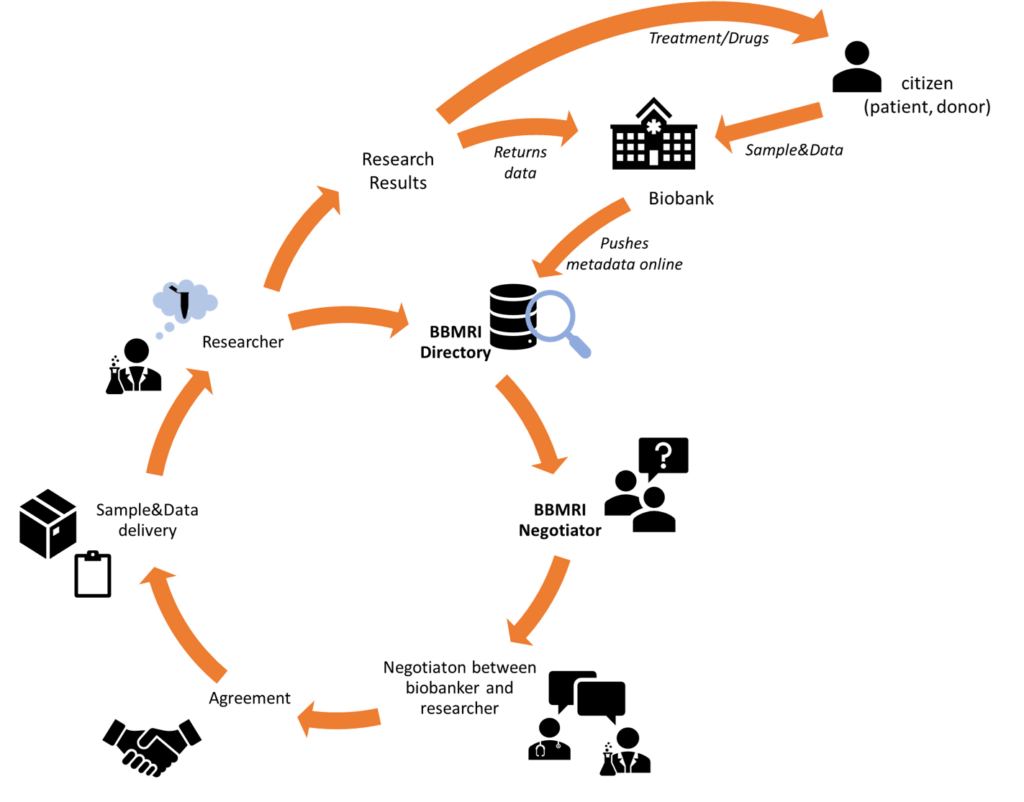
The diagram above schematically shows the role a biobank plays in research and how important it is for patients, citizens and donors of the processed biological material.
1. Citizen – If a patient or healthy individual has a biological sample taken during an examination and not all of it is used for laboratory tests, it can be sent to a biobank for longer-term storage (for a year, or even for decades).
2. Biobank – Biological material suitable for future research, which would be a shame to discard after the examination, is stored in the biobank together with detailed information about its content and donor. It is then offered to scientists for research purposes. Data on the storage process of the given material (sample) are also kept.
3. BBMRI Directory – serves as a catalogue, with filtering, of the sample collections on offer from biobanks across the whole BBMRI-ERIC consortium, which makes it the largest biobank catalogue in existence. The Directory is an important place for researchers looking for samples. Once the requester has finished selecting collections, they send a request to the relevant biobanks using the Negotiator tool.
4. BBMRI Negotiator – is the tool in which the requester of samples negotiates with biobanks. The collections selected in the Directory have responsible persons, and the Negotiator can contact them.
5. Negotiation – It is not uncommon for details about the requested materials, data and quantities to need to be agreed. The Negotiator enables communication with all contacted biobanks at once, or private communication with some of them.
6. Agreement – After successful negotiation in the Negotiator, a contract is signed: the Material and Data Agreement.
7. Delivery – Samples and associated data are sent to the requester (researcher).
8. Researcher – investigates and carries out experiments until reaching new knowledge.
9. Research Results – The results of research carried out on biobank samples (data) should be offered to the biobank for storage in place of the released samples. In the future, mainly data will thus be preserved, saving resources on repeated analyses of identical samples.
10. Research Results – Outputs of clinical studies and of the research itself return to patients and people in prevention programmes in the form of new treatment techniques and methods.
You too can contribute to disease research this way. All you need to do is sign an informed consent!